What the Final EIS Confirms About Foundry Ridge — and What Still Remains Unanswered
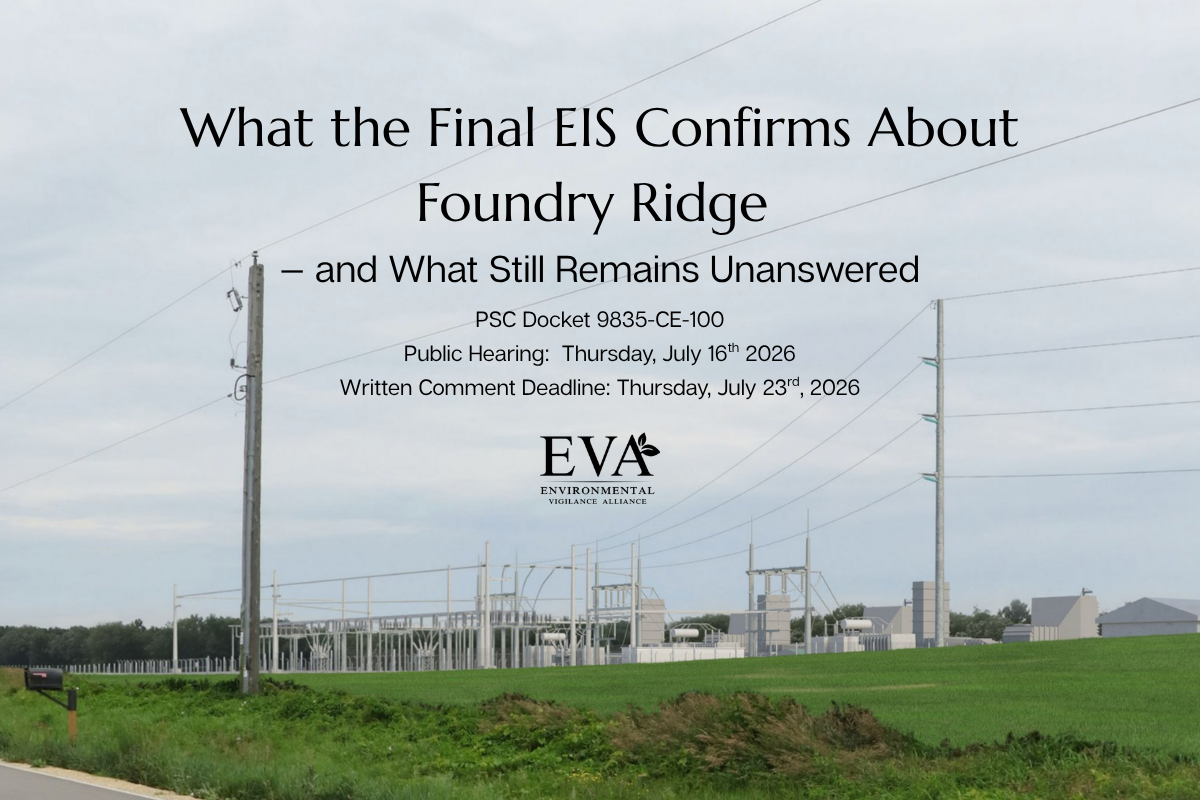
Foundry Ridge Energy Center | PSC Docket 9835-CE-100
EVA | Environmental Vigilance Alliance
The Final Environmental Impact Statement for the proposed Foundry Ridge Energy Center was released by the Public Service Commission of Wisconsin and Wisconsin Department of Natural Resources on May 28th, 2026.
For Darien residents and surrounding communities, the Final EIS is an important document — but it does not approve the project, and it does not resolve the core public concerns raised throughout this docket.
The proposed Foundry Ridge Energy Center would be a 324-megawatt natural gas-fired simple-cycle combustion turbine facility in the Town of Darien. It would include three gas turbines, a generator tie line, a new onsite well, gas-pipeline-related infrastructure, stormwater and wastewater systems, and other associated facilities.
The PSC still must decide whether to approve, deny, modify, or place conditions on the application. That means public participation still matters.
A merchant plant with possible future utility ownership
Foundry Ridge is being reviewed as a wholesale merchant plant, which matters because merchant plants are not required to provide the same need, cost, no-build, energy-efficiency, demand-response, or generation-expansion analysis that would normally apply to a public utility project. The revised application states that, because the project is a wholesale merchant plant, several of those analyses “need not be provided.”
At the same time, the application also states that Foundry Ridge may “sell or assign the Project, or a portion thereof, to one or more public utilities or other qualified entity or entities at any time.”
This raises a serious public-interest question:
If utility ownership is already possible or being pursued, should this project be allowed to avoid full public need, cost, alternatives, and ratepayer-impact scrutiny simply because it is currently structured as a merchant plant?
A separate PSC docket also exists for Wisconsin Electric Power Company’s proposed acquisition of an ownership interest in the Foundry Ridge Energy Center and related facilities: PSC Docket 6630-BS-103. That separate acquisition docket should be considered part of the broader public context, especially when residents are being told this project is a merchant plant.
The project is connected to broader data-center and AI-driven energy demand
The revised application explicitly discusses significant new load sources, including data centers and artificial intelligence processing facilities, expected to come online in southeastern Wisconsin. It cites Wisconsin Electric’s statement that electric demand in its service territory is expected to grow dramatically because of large data-center customers.
That does not prove Foundry Ridge is tied to one specific data center. But it does show that this project is part of a broader energy-demand conversation that includes data centers, AI processing, transmission constraints, and utility planning.
This is why EVA believes Foundry Ridge should not be reviewed as an isolated local facility. Wisconsin is seeing data centers, gas plants, transmission lines, substations, solar, battery storage, water infrastructure, and utility acquisition proposals emerge in overlapping ways. The impacts are cumulative, even when the dockets are separate.
“Peaker plant” does not mean “rarely operating”
Foundry Ridge has often been described as a peaker plant. But the application record is more complicated.
The revised application states that the facility would be designed for continuous service, even though Foundry Ridge anticipates it would primarily operate during periods of peak electrical demand. It also states that daily and weekly capacity factors may be as high as 100%, while annual capacity factor is expected to average around 20%.
PSC staff later asked why Foundry Ridge is seeking 68,800 dekatherms per day of firm natural gas supply — approximately 83% of the facility’s maximum natural gas burn rate — while also describing the plant as constrained by capacity-factor limits and likely to operate in a peaking or intermediate role.
Foundry Ridge responded that it cannot reasonably provide projected daily operation by week for a future year because actual dispatch would depend on weather, load levels, transmission conditions, generator outages, renewable output, fuel prices, and MISO market needs.
For residents, this matters. The PSC should not minimize impacts based only on simplified “peaker” messaging when the record shows operational flexibility, continuous-service design, and uncertainty about actual dispatch.
Air pollution and health concerns remain central
DNR air testimony states that Foundry Ridge would be classified as a synthetic minor source for Prevention of Significant Deterioration permitting, with proposed emissions kept below the 250 tons-per-year PSD major-source threshold. But “below a regulatory threshold” does not mean “no impact.”
DNR testimony lists potential emissions including NOx at 148.69 tons/year, carbon monoxide at 248.08 tons/year, PM2.5 at 48.23 tons/year, and greenhouse gases at 517,490 tons CO₂e/year.
The same testimony also states that, as of May 19, 2026, DNR had not yet made a preliminary determination on whether the proposed project was approvable under air-permit requirements. DNR still needed to complete its analysis, issue a preliminary determination, provide an opportunity for public comment, and consider those comments before making a final air-permit decision.
That means one of the most important public-health documents — the final air permit and enforceable emissions limits — was still not complete while residents were preparing for the public hearing.
Expert health testimony submitted in the docket also raises serious concerns. Dr. Andrew Lewandowski testified that the plant would emit pollutants associated with respiratory, cardiovascular, neurological, autoimmune, pregnancy-related, and climate-related harms, and that even if the facility operates within National Ambient Air Quality Standards, people in the dispersal path of emissions may still experience health impacts.
Dr. Jonathan Patz and UW-Madison researchers also evaluated air-quality and health effects from Foundry Ridge and Red Oak Ridge together. Their testimony estimated that combined emissions from the two plants could contribute to 4 excess premature deaths in the first year of operation and 118 excess premature deaths over 30 years, including 41 in Wisconsin. They also estimated $486 million in Wisconsin air-quality damages over the facilities’ operating lifetimes.
That testimony is not a PSC finding. It is expert testimony submitted into the record. But it directly challenges the idea that regulatory compliance alone should be treated as proof of no public-health harm.
Water, wastewater, and stormwater questions remain important
The wastewater plan changed during the process. The current approach appears to move away from earlier surface-water discharge concerns for certain process wastewater streams, but it does not eliminate all water-related risk.
DNR Wastewater Section Manager Nathaniel Willis testified that the facility would generate two types of wastewater: stormwater accumulated in transformer secondary containment areas that may have been contaminated with petroleum, and cooling tower blowdown. At the time of his testimony, the applicant was not proposing to discharge cooling tower blowdown to waters of the state, but was seeking to discharge secondary containment water.
Willis testified that the applicant proposes to discharge secondary containment water through five different outfalls to groundwater, with visual inspections occurring at least quarterly and after rain events greater than 0.5 inches that cause accumulation in the containment structures. If oil sheen or turbidity is observed, the water would not be discharged and would instead be containerized and hauled offsite.
That means the revised wastewater plan still relies heavily on visual inspection, operator procedures, discharge-management plans, and later permit coverage.
Construction stormwater is also not fully settled. DNR Storm Water Engineer Samantha Whitens testified that the project would require stormwater permit coverage because it involves more than one acre of land-disturbing construction, but that the Notice of Intent had not yet been submitted and is not required until at least 14 working days before land disturbance begins.
Whitens explained that uncontrolled stormwater from construction can move sediment into ditches and water bodies, degrade water quality, damage fish gills, harm spawning habitat, increase algae growth, and carry concrete washout, chemicals, and trash into waterways. She also noted that winter construction creates additional erosion-control challenges because vegetation cannot be established after the growing season, sediment basins can freeze, and rain on frozen ground can increase runoff.
Given the proximity of Turtle Creek, Little Turtle Creek, wetlands, farms, homes, livestock operations, and private wells, these concerns should not be treated as minor technical details.
Nearby residents have documented real community impacts
Resident testimony in the docket shows how close this project would be to homes, farms, existing energy infrastructure, and natural resources.
Kelly Scott testified that her family lives approximately 650 yards from the proposed site, and that her husband’s family farm of more than 100 years is about 0.44 miles from the site. She raised concerns about the concentration of energy infrastructure in Darien, the merchant-plant structure, future ownership transparency, agricultural impacts, Turtle Creek, lighting, environmental monitoring, farmland preservation, public outreach, and cumulative impacts.
Her exhibits include aerial photographs showing nearby home and farm structures in relation to the existing Darien Solar landscape, and a map showing Turtle Creek curving through the area near the proposed project location.
This is an important reminder: Foundry Ridge is not being proposed in an empty industrial zone. It is being proposed in a rural community with homes, farms, livestock, waterways, recreation areas, and existing energy infrastructure already nearby.
Property value and rural character concerns are part of the record
Residents have also raised economic concerns.
Real estate appraiser Scott MacWilliams testified regarding one nearby property, estimating its fair market value at $2,520,000 without the Foundry Ridge project and $1,764,000 with the project completed — a projected loss of $756,000.
His testimony states that rural estate properties are strongly affected by privacy, views, tranquility, outdoor enjoyment, and perceived health and safety risks. He also states that peaker plants tend to lower nearby property values because of air pollution, noise, visual and industrial character, nuisance factors, and perceived health risks.
This is one appraisal opinion in the docket. It should not be read as a prediction for every property. But it shows that property-value impacts are not merely emotional fears; they are part of the public record.
The Alternative Site should be rejected
Even if the PSC does not deny the entire project, the Alternative Site deserves particular concern.
The record identifies concerns related to proximity to residences, greater agricultural impacts, potential additional infrastructure, proximity to Turtle Creek Wildlife Area, noise concerns, and archaeological contingencies.
PSC Historic Preservation Officer Andrew Craft testified that one archaeological site was identified within the Alternative project location. While the current design does not anticipate direct impacts, the testimony states that if the alternative location is used, a Phase II evaluation would be needed for that site to determine historic-property eligibility.
The Alternative Site should not be treated as an acceptable fallback.
The record shows repeated clarification was needed
The PSC’s data-request index shows that staff sought additional information on emergency response, wastewater outfalls, air permits, well impacts, well mitigation, gas-pipeline timing, oil-leak separation, SPCC planning, wastewater chemistry, sampling, drain tiles, visual screening, noise agreements, gas-supply backup planning, lighting, brownfield alternatives, airport plume concerns, and the modified wastewater plan.
This matters because the project details have continued to evolve throughout the review process. Residents should not be expected to accept broad assurances when key information has required repeated clarification and some permits or plans remain pending.
What Darien residents can still ask for
At the July 16 public hearing, residents can ask the PSC to:
Deny the CPCN because the project has not been shown to be necessary through a full public-utility-style need and alternatives analysis, despite possible future utility ownership and links to large data-center-driven demand.
Suspend or delay approval until air permitting, stormwater planning, wastewater protections, gas-supply arrangements, ownership and cost implications, and cumulative impacts are fully reviewed and publicly available.
Reject the Alternative Site because it appears to create greater impacts and should not be selected.
Require enforceable conditions if approval is granted, including no process wastewater discharge to surface waters without a new public process; independent air, water, noise, and groundwater monitoring; baseline and ongoing private-well testing; winter construction controls; public reporting; emergency response funding; road-damage agreements; visual screening; lighting limits; and clear limits on operating hours, startup/shutdown events, fuel use, and emissions.
Wisconsin needs cumulative-impact review
Foundry Ridge is not only a Darien issue. It is part of a larger statewide question.
Wisconsin is facing rapid growth in data centers, energy demand, gas plants, transmission infrastructure, substations, solar, battery storage, water infrastructure, and utility acquisition proposals. These projects are often reviewed one docket at a time, while the impacts are cumulative.
Darien should not be treated as a convenient location for layered energy infrastructure simply because infrastructure already exists here.
Before Wisconsin approves more data centers and the energy infrastructure being built to serve them, the state should complete a comprehensive cumulative-impact review that evaluates air, water, climate, farmland, public health, emergency response, property values, grid need, ratepayer impacts, and long-term land-use change.
The Final EIS does not end the conversation. It confirms why the conversation still matters.
Sources reviewed
This article is based on public documents filed in PSC Docket 9835-CE-100, including the Final Environmental Impact Statement, Foundry Ridge CPCN application materials, PSC data requests and responses, DNR direct testimony, expert testimony, and resident testimony.
Readers can search the PSC Electronic Records Filing system by docket number 9835-CE-100 and PSC reference number.
Relevant filings include:
Final Environmental Impact Statement — PSC REF #592366 / Exhibit filing PSC REF #595091
Foundry Ridge CPCN Application Narrative Redlined — PSC REF #592365
DNR Air Testimony, Hanna Moscho — PSC REF #593208
DNR Stormwater Testimony, Samantha Whitens — PSC REF #593207
DNR Wastewater Testimony, Nathaniel Willis — PSC REF #593206
PSC Data Request Panak 11 — PSC REF #596528
Foundry Ridge Response to Data Request Panak 11 — PSC REF #597140
PSC Data Request Panak 12 — PSC REF #597230
Kelly Scott Testimony — PSC REF #593275
Dr. Andrew Lewandowski Testimony — PSC REF #593200
Dr. Jonathan Patz Testimony — PSC REF #593202
Scott MacWilliams Testimony — PSC REF #593204
Andrew Craft Historic Properties Testimony — PSC REF #593243
Also relevant: PSC Docket 6630-BS-103, Application of Wisconsin Electric Power Company for Approval to Acquire an Ownership Interest in the Foundry Ridge Energy Center and Related Facilities in the Town of Darien, Walworth County, Wisconsin.