New Questions Arise in the Final Foundry Ridge Record Before the July 23 Comment Deadline
A review of Foundry Ridge’s final-filed application and testimony identified conflicting construction schedules, inconsistent descriptions of the proposed gas-pipeline route, unclear operating limits, an incorrect acreage calculation, and unresolved interconnection details. These issues should be corrected before the Public Service Commission decides whether to approve the project.
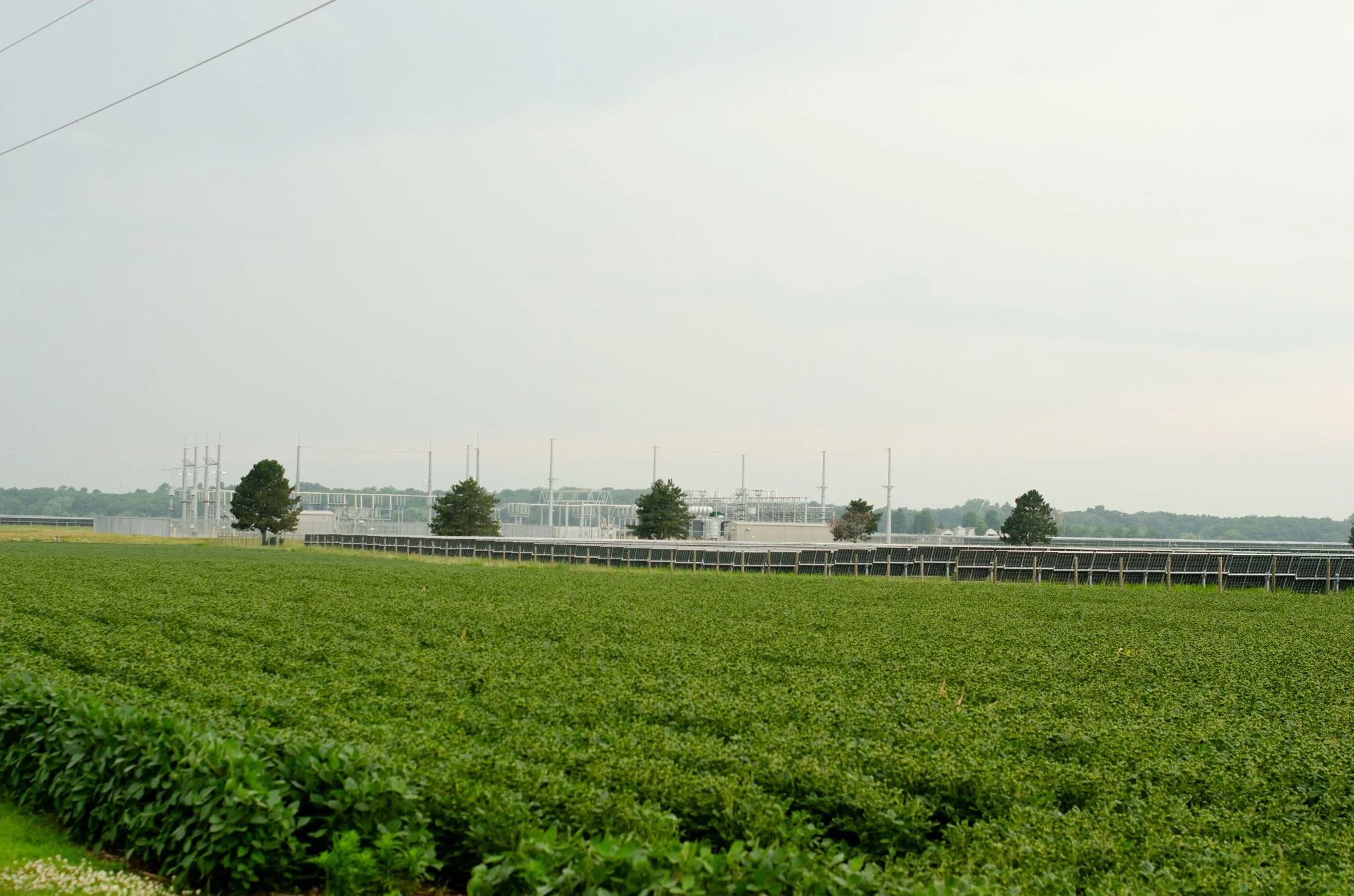
Farmland and existing energy infrastructure near the proposed Foundry Ridge Energy Center site in the Town of Darien. Photo by Darcey Rojas/EVA.
This article distinguishes between confirmed errors, apparent inconsistencies, and questions that require clarification. It does not allege that every discrepancy was intentional.
The Public Service Commission of Wisconsin is accepting written comments on the proposed Foundry Ridge Energy Center through July 23, 2026. Comments must be received by the Commission by that date.
As the deadline approaches, EVA reviewed the application and testimony that Foundry Ridge Energy Center LLC designated as its final-filed evidence.
This review distinguishes between:
confirmed errors, such as invalid dates and an incorrect percentage calculation;
apparent inconsistencies, where two final documents describe the same issue differently; and
unresolved questions, where the record does not yet provide enough information to understand the project’s full purpose, operation, or associated infrastructure.
This article does not allege that every discrepancy was intentional. It asks whether the Commission has a sufficiently clear, accurate, and internally consistent record to make a decision affecting the Town of Darien and surrounding communities.
An important clarification about the final application
On July 21, Foundry Ridge filed PSC REF 598750, the clean public version of its revised Application Narrative r2. The following morning, it filed PSC REF 598922, an exhibit index identifying PSC REF 592365 as the earlier public redline and PSC REF 598750 as the final clean version.
This means the July 21 filing should not be described as an entirely new application introduced after the public hearing. It is the clean version of revisions that had previously been filed in redline form. However, it is also the application narrative the applicant has now designated as part of its final-filed evidentiary record.
The question is therefore not simply why the document was filed late. The more important question is why several errors, inconsistencies, and unresolved project details remain in the final record.
Two different construction schedules—and several impossible dates
The final clean application states that construction would begin on September 1, 2026, with commercial operation beginning on March 31, 2028.
Its construction table also lists “February 31, 2028” as the end of hot commissioning—a date that does not exist.
The final-filed testimony of Invenergy Manager of Thermal Engineering Alex Hrynchuk provides a substantially different schedule. Hrynchuk states that construction would begin in January 2027 and be completed in August 2028.
The table reproduced in his testimony includes multiple dates that occur before the stated construction start:
grading begins February 4, 2027, but ends August 3, 2026;
testing and pre-commissioning begin January 13, 2028, but end June 14, 2026;
Unit 1 reaches substantial completion May 31, 2026;
Unit 2 reaches substantial completion June 30, 2026; and
Unit 3 reaches substantial completion July 31, 2026.
The same testimony lists commercial operation on August 31, 2028.
These are more than small differences between preliminary estimates. They are two separate project schedules, accompanied by several chronologically impossible entries in testimony submitted by the applicant’s engineering witness.
The Commission should require one corrected and authoritative schedule and explain which timeline was used to evaluate:
construction traffic and road impacts;
seasonal environmental restrictions;
farming activities;
emergency-response preparation;
other construction occurring in the area; and
the overall duration of disruption to nearby residents.
Has a preliminary gas-pipeline route been identified?
Foundry Ridge would require a new natural-gas lateral constructed, owned, and operated by Wisconsin Electric Gas Operations, or WE-GO.
The application estimates that the lateral would be:
approximately 5.3 miles for the proposed site;
approximately 2.5 miles for the alternative site; and
approximately 16 inches in diameter.
But the final application repeatedly states:
“Preliminary routing for the natural gas pipeline lateral from WE-GO is not currently available.”
Hrynchuk’s final-filed testimony instead states:
“Preliminary routing for the pipeline lateral has been identified.”
These statements appear inconsistent.
They do not prove that anyone intentionally withheld a route. It is possible that WE-GO has identified a preliminary route that has not yet been provided to Foundry Ridge or filed publicly. But that possibility creates its own questions.
The Commission should clarify:
whether a preliminary route currently exists;
who developed or possesses it;
which properties and landowners may be affected;
whether affected landowners have been notified;
which roads, farms, wetlands, waterways, and other resources could be crossed;
why the route is absent from the CPCN application record; and
whether its direct and cumulative impacts have been evaluated.
The gas lateral is not an optional feature. Foundry Ridge could not operate without fuel delivery.
A separate applicant response filed after the public hearing states that if WE-GO cannot provide service, Foundry Ridge could pursue a direct connection to the Guardian or ANR pipelines. The applicant acknowledges that this alternative is not considered in the current CPCN application and would introduce additional cost and schedule risks.
That makes it even more important for the Commission to determine what gas infrastructure is actually contemplated before approving the generating facility.
The “20 percent peaker” description does not tell the whole story
Foundry Ridge is frequently described as a peaking facility expected to operate at an annual capacity factor of approximately 20 percent.
The final application does say the plant is expected to operate primarily during periods of peak electrical demand and to have an annual capacity factor of approximately 20 percent.
But the same application also says the facility would:
be designed for continuous service;
be available to operate 24 hours per day, seven days per week and 365 days per year, except for outages;
be capable of daily and weekly capacity factors as high as 100 percent;
have a fuel-based limit equivalent to 2,338 hours per turbine at full load, which the application describes as approximately a 27 percent capacity factor; and
potentially operate more than 2,338 actual hours when running below full load.
Those statements are not necessarily technically incompatible. A plant can remain idle for much of a year while operating continuously for days or weeks during other periods.
But they demonstrate that “20 percent” is not the same as a clear statement that the plant would operate during only 20 percent of the year.
The record becomes more confusing when compared with the applicant’s July 9 response to PSC staff. That response says the project would be subject to permit limits that would cap annual operation at approximately a 20 percent capacity factor. It also states that the applicant cannot reasonably provide projected daily operation by week because dispatch would depend upon weather, load, transmission conditions, generator outages, renewable output, fuel prices, and MISO market needs.
The Commission should require a definitive explanation of:
the precise enforceable operating limit;
whether the legally applicable limit is equivalent to 20 percent or 27 percent at full load;
the maximum actual number of operating hours;
how long all three turbines could operate continuously;
whether operation at partial load could substantially increase the number of hours neighbors experience plant activity; and
which operating scenario was used for the air-quality, health, noise, water-use, and other impact analyses.
The environmental review should be based upon the maximum reasonably foreseeable and legally permissible operation—not solely upon an anticipated average.
What does “peak demand” mean when one customer subscribes to the entire plant?
The operating-profile question cannot be separated from the project’s actual economic purpose.
The Foundry Ridge application identifies the project as a wholesale merchant plant. It says significant new loads—including data centers and artificial-intelligence processing facilities—are anticipated in southeastern Wisconsin and may exceed existing generation and transmission capabilities. It also connects Foundry Ridge to Wisconsin Electric’s Very Large Customer and Bespoke Resource tariff and WEC Energy Group’s generation plans.
The related Wisconsin Electric acquisition docket provides more specific information.
Wisconsin Electric states that:
the subscribing Very Large Customer has elected to subscribe to 100 percent of Foundry Ridge as a Bespoke Resource;
the project is needed to meet that VLC’s load obligations; and
“but for the incremental load from the VLC,” this dispatchable resource would not be required for Wisconsin Electric’s generation portfolio.
This does not mean every unit of electricity would travel through a dedicated wire directly to one customer. Foundry Ridge would interconnect with the regional electric system and could be dispatched through MISO.
But the related record establishes that the customer’s incremental demand is the but-for cause of Wisconsin Electric’s stated need for the plant, and that the customer is economically subscribing to the full resource.
That raises a central unanswered question:
What does “peak electrical demand” mean when the plant would not otherwise be required and one Very Large Customer is subscribing to 100 percent of it?
Is the projected operating profile based on:
normal peaks across the MISO region;
Wisconsin Electric’s system peaks;
the VLC’s projected hourly and seasonal demand;
periods when that customer’s addition places new stress on the utility system;
or a combination of those conditions?
The applicant’s July 9 response says expected utilization was developed from regional market assumptions and historical operating patterns for comparable peaking and intermediate resources. It does not clearly establish that the forecast incorporates the actual hourly and seasonal load profile of the VLC subscribing to the project.
A conventional independent merchant peaker and a utility-acquired resource whose need arises from one extraordinary new customer may not have the same expected purpose or dispatch profile.
The Commission should require an operating analysis that reflects the project’s actual customer arrangement rather than relying only on the generalized term “peaker plant.”
The scale of firm gas service raises additional questions
PSC staff specifically questioned why Foundry Ridge is seeking approximately 68,800 dekatherms per day of firm gas service, an amount staff described as approximately 83 percent of the facility’s maximum gas burn rate, while also characterizing the plant as a peaking or intermediate resource limited to an approximately 20 percent annual capacity factor.
The applicant responded that firm capacity is needed to ensure fuel is available when the plant is dispatched during extreme heat, cold weather, or other high-load conditions. It said firm gas capacity should not be treated as a direct proxy for annual operation.
That explanation is reasonable as far as it goes. Firm delivery capacity and annual usage are not the same thing.
However, the response also acknowledges that the firm-supply figure is an estimate used to support engineering and that design of the pipeline connection remains ongoing.
Before approval, the Commission should identify:
the final firm-gas requirement;
the facilities needed to provide it;
the final pipeline route;
the cost of the gas lateral and related upgrades;
who bears those costs; and
whether the gas-service assumptions are consistent with the operating profile used in the environmental review.
The acreage calculation is wrong by a factor of 100
In his final rebuttal testimony, Invenergy Director of Development Johnathan Shelton states that the approximately 16-acre plant footprint represents 0.00074 percent of the Town of Darien’s approximately 21,568 acres.
The correct calculation is:
16 ÷ 21,568 × 100 = approximately 0.0742 percent.
The percentage stated in the testimony is too small by a factor of 100.
The corrected figure still represents a relatively small portion of the entire Town. But the calculation was used to respond to a land-use concern that was not based simply on the number of acres inside the plant fence.
Kelly Scott’s surrebuttal explains that her concern involved the conversion of land that has long been included in Walworth County’s Farmland Preservation Program. She describes this as a land-use compatibility issue rather than a mathematical comparison with the Town’s total acreage.
The 16-acre comparison also excludes other land disturbance.
The application identifies:
approximately 16 permanent acres and 15 temporarily disturbed acres at the proposed site, plus approximately 1.1 acres of proposed gen-tie right-of-way; and
approximately 16 permanent acres and 9 temporarily disturbed acres at the alternative site, plus approximately 22 acres of alternative gen-tie right-of-way.
The Commission should evaluate the complete permanent and temporary footprint, the transmission corridor, and the land’s agricultural-preservation history—not only the fenced generating site.
The Alternative Gen-Tie Line is described differently in final documents
The application states that the Alternative Gen-Tie Line would connect the alternative site to the Darien Solar Substation approximately 2.2 miles away. It says approximately 1.8 miles of that line would be double-circuited and attached to the existing RCEC Bradford–West Darien transmission line.
Hrynchuk’s final testimony instead describes the Alternative Gen-Tie Line itself as approximately 1.8 miles long and says it would interconnect with the existing ATC transmission line.
This may be a witness confusing the 1.8-mile shared-structure portion with the total route. But the application and engineering testimony should describe the same facility consistently.
The applicant should clarify:
the total line length;
the complete route;
the actual point of interconnection;
which portions Foundry Ridge and ATC would construct;
how many structures would be required; and
the acreage and landowners affected.
The final interconnection configuration remains unresolved
Foundry Ridge is pursuing both surplus interconnection service associated with Darien Solar queue position J850 and a standalone interconnection process through queue position J4028.
Shelton’s final rebuttal testimony says the project intends to use both methods for commissioning and operation, but that the exact configuration will be finalized after further MISO review. It anticipates the surplus agreement in August 2026 and the standalone agreement in 2027.
The final application also describes another possible interconnection scenario if property rights for the current alternative route cannot be obtained. Under that scenario, the applicant could seek a material modification to shift the point of interconnection and provide ATC with an approximately five-acre graded site for a new switchyard.
These may be ordinary contingencies in a developing interconnection process. But the Commission is being asked to authorize the project before the final configuration, agreements, construction responsibilities, upgrades, and related impacts are settled.
The Commission should determine what facilities it is approving and whether later changes would require additional environmental review or public participation.
Why the merchant classification matters
The PSC’s Foundry Ridge case page states that because the project is classified as a wholesale merchant plant, the Commission does not review project need or cost in this CPCN proceeding.
The application similarly invokes merchant status to decline to provide substantial portions of the requested analysis, including:
overall project costs;
long-term demand and energy forecasts;
generation-expansion modeling;
capacity and reserve-margin information;
analysis of purchased-power alternatives;
a full energy-efficiency and demand-response analysis;
a meaningful no-build analysis; and
comparison with renewable and other resource alternatives.
At the same time, the application relies on expected data-center and artificial-intelligence demand, Wisconsin Electric’s utility tariffs, and WEC’s generation plans to explain why the plant is appropriate.
The related acquisition docket then states that Wisconsin Electric intends to acquire the project, one VLC is subscribing to the entire resource, and the plant would not be required but for that customer’s incremental load.
This creates a fragmented review:
utility and VLC demand are used to explain why the plant should exist;
merchant status is used to avoid the full utility need, cost, efficiency, and alternatives analysis; and
associated gas and transmission infrastructure continues to be developed through separate proceedings and future agreements.
The Commission should evaluate these records together. Public convenience and necessity cannot be meaningfully understood if the project’s purpose, ownership, gas supply, transmission configuration, and customer arrangement are treated as disconnected issues.
What residents can ask the Commission to do
Residents who have not yet submitted a comment may ask the Commission to:
require a corrected and internally consistent final application and construction schedule;
define the maximum enforceable operating limits and explain the 20-percent-versus-27-percent descriptions;
define “peak demand” using the VLC’s actual projected load;
disclose and evaluate the gas-lateral route before approving the plant;
determine the final gas capacity, costs, and cost responsibility;
correct the acreage calculation and evaluate the full permanent and temporary land disturbance;
clarify the total Alternative Gen-Tie Line route and construction responsibilities;
require the final interconnection configuration and material upgrade information;
conduct an integrated review of project need, alternatives, and cumulative impacts; and
extend or reopen public comment if material corrections or new route and interconnection information are filed after July 23.
A public comment does not need to address every issue. One specific concern, supported by a PSC reference number and a clear request for Commission action, can be meaningful.
Foundry Ridge docket: 9835-CE-100
Written comments must be received by: July 23, 2026
Submit a comment: PSC Public Comment Portal
Official source documents
PSC REF 598750 — Foundry Ridge CPCN Application Narrative r2, Clean
PSC REF 597140 — Response to PSCW-NJB-11.1, Operating Profile and Firm Gas Service
PSC REF 598228 — Response Regarding Alternative Gas Service and Gas-Lateral Costs
PSC REF 594996 — Wisconsin Electric Response Confirming 100% VLC Subscription
PSC REF 596268 — Wisconsin Electric Response Regarding Need for VLC Load Obligations
PSC REF 596269 — Wisconsin Electric Response: Resource Not Required But for VLC Load
PSC REF 598382 — July 16 Foundry Ridge Public Hearing Transcript